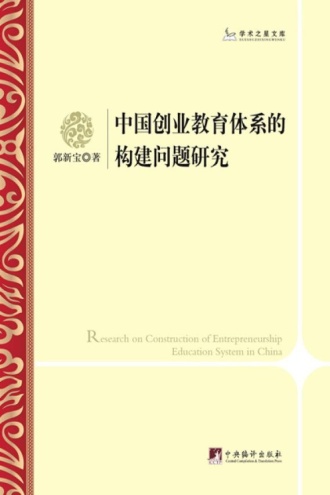
中国创业教育体系的构建问题研究
¥23.80
作品简介
创业教育有利于提升学员和社会的创业精神、创业意愿和创业能力,能够加快知识溢出,有利于创新型经济的更快发展,是构建和发展创新型国家的源动力。建设创新型国家的战略基点是增强自主创新能力,关键是优化创新环境、培养创新人才、提高创新效益等三个方面。创业教育对建设创新型国家的战略基点和三个方面都有巨大的推动所用。《学术之星文库:中国创业教育体系的构建问题研究》系统研究了创业教育的科学性,合理构建了中国创业教育体系,对有效推进中国创业教育的开展,具有重要的理论和实践意义。《学术之星文库:中国创业教育体系的构建问题研究》提出,在中国大学要形成文化课、专业课、创业课互相渗透、功能互补的立体多元化的创业教育系统。但创业教育是一个系统工程,要想使创业教育真正取得成效,仅仅依赖高校创业教育远远不够,还需要家庭、学校和整个社会来提供支持与保障。
郭新宝,男,1970年2月生,陕西省大荔县人,河南科技大学管理学院副教授,硕士生导师,副院长,主要研究方向是创业与创业学,技术经济与系统工程。发表论文30多篇,其中CSSCI源刊论文6篇,EI源刊论文3篇,EI/SCI/ISTP收录论文10篇。主持和参与完成国家和省部级项目6项,获省部级二等奖2项。出版专著2部。
作品目录
Introduction
1 Review of related researches and practices
1.1 Review of the development and research of entrepreneurship education
1.1.1 Durance period of entrepreneurship education(before the 1970s)
1.1.2 Early development period of entrepreneurship education(from 1970s to 1990s)
1.1.3 Prosperous development period of entrepreneurship education(from 1990s to now)
1.2 The development and research of entrepreneurship education in China
1.2.1 Promotion of entrepreneurship education from Chinese government
1.2.2 Research and practice of entrepreneurship education in China
1.3 Future development trend of entrepreneurship education
1.3.1 Clarification of concept and content in entrepreneurship
1.3.2 Evaluation on the effect of entrepreneurship education course
1.3.3 Combination of school and industry for entrepreneurship education
2 Research on spillover effects of entrepreneurship education
2.1 Entrepreneurship education and establishment of innovative country
2.1.1 Entrepreneurship education can enhance national independent innovation ability
2.1.2 Entrepreneurship education improves the innovation environment of a country through entrepreneurial culture
2.1.3 Entrepreneurship education is a compulsory part for training innovative talents
2.1.4 Entrepreneurship education can improve innovation efficiency and the sustainability of innovation investment
2.2 Research on entrepreneurship education based on perspective of entrepreneurship capital
2.2.1 Influence of the three kinds of entrepreneurship capital on entrepreneurship
2.2.2 Entrepreneurship education based on human capital
2.2.3 Entrepreneurship education based on social capital
2.2.4 Entrepreneurship education based on psychological capital
2.3 Research on knowledge spillover of entrepreneurship education
2.3.1 Concept of knowledge spillover effect
2.3.2 Research on entrepreneurship and entrepreneurship education based on the perspective of knowledge spillover
2.3.3 Ways of knowledge spillover in entrepreneurship education
2.3.4 Analysis on knowledge spillover effect of entrepreneurship education
2.3.5 Analysis on knowledge spillover ability of Chinese entrepreneurship education
3 Scientificity of entrepreneurship education
3.1 Historical inevitability of entrepreneurship education
3.1.1 Conceptual framework of entrepreneurship education
3.1.2 Entrepreneurship education and entrepreneurship
3.1.3 Development history and present situation of entrepreneurship education
3.2 Objective reality of entrepreneurship education
3.2.1 Improved external environment of entrepreneurship education
3.2.2 Increasingly mature internal factors of entrepreneurship education
3.2.3 Reality significance of entrepreneurship education
3.3 Assumption, goals, and evaluation of entrepreneurship education
3.3.1 Assumption of entrepreneurship education
3.3.2 Goals of entrepreneurship education
3.3.3 Evaluation of entrepreneurship education
3.4 Main modes of Chinese entrepreneurship education
3.4.1 Combining the first class with second class to carry out entrepreneurship education
3.4.2 Establishment of functional and substantiated entrepreneurship education institutions
3.4.3 Comprehensive entrepreneurship education regarding innovation as the core
3.5 Construction of Chinese entrepreneurship education system
3.5.1 Civilization goal of entrepreneurship education
3.5.2 Methods of conducting of entrepreneurial education
3.5.3 Curriculum design of entrepreneurial education
3.5.4 Practice of entrepreneurship education
4 Proposals for the development of entrepreneurship education in China
4.1 Cultivation system of entrepreneurship education
4.1.1 Constitution of basic entrepreneurship quality
4.1.2 Target positioning of Chinese entrepreneurship education
4.1.3 Curriculum system of entrepreneurship education
4.1.4 Content system of entrepreneurship education
4.1.5 Entrepreneurship education method and model
4.2 Management system of entrepreneurship education
4.2.1 Organization of entrepreneurship education
4.2.2 Teaching management system of entrepreneurship education
4.2.3 Student management system for entrepreneurship education
4.3 Teacher groups of entrepreneurship education
4.3.1 University teachers
4.3.2 Entrepreneurship practitioner
4.3.3 Government officials
4.3.4 Venture investor
4.4 Operation environment of entrepreneurship education
4.4.1 Atmosphere of public opinion
4.4.2 Entrepreneurship basic education and family education
4.4.3 Entrepreneurial support and service system
4.5 Government's promotion to entrepreneurship education
4.5.1 Implementation of the national plan of entrepreneurship education
4.5.2 Creating entrepreneurial education system in universities
4.5.3 Establishment of good policy and legal environment
4.5.4 Guiding the active participation of all the enterprises including private enterprises
Reference