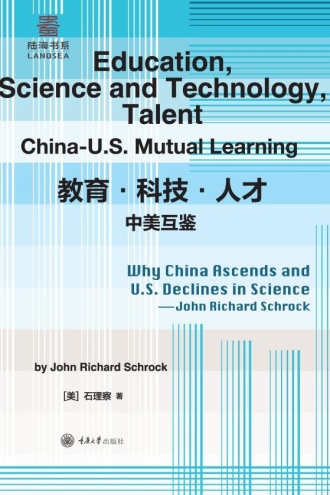
教育·科技·人才:中美互鉴(汉文、英文)
Education,Science and Technology,Talent:China-U.S. Mutual Learning:
¥61.60
作品简介
本书系作者多年追踪观察全球科学发展的研究成果。书中既有作者对中国教育科技人才一体化发展的肯定、对创新能力培养的建议和对科研诚信建设的提醒,也有对美国科学发展现状的隐忧与自省。科学的繁荣离不开多元文化的交流与不同视角的碰撞,我们特别邀请浙江大学张月红教授和重庆大学张育新教授分别撰写了序言和中文评述,以期帮助读者从多元视角出发进行理性反思,并从中获得更多启发与借鉴。
作者:[美]石理察。
作品目录
编者按
Forward The Story of This Book
序言 一本书的故事
Preface
前言
China Ascends in Science While U.S. Declines
Georgetown University’s Center for Security and Emerging Technology, 2021
The Global Distribution of STEM Graduates: Which Countries Lead the Way? 2023
The Belfer Center “The Great Tech Rivalry: China versus the U.S.” 2021
“Highly Cited Researchers” Report by Institute for Scientific Information (ISI) at Clarivate in London, 2021
U.S. National Science Foundation “The State of U.S. Science and Engineering 2022”
“Winners and Losers in U.S. -China Scientific Research Collaborations” by Lee and Haupt, 2020
Japan’s National Institute of Science and Technology Top-cited Scientific Research Papers, 2022
Home Citations Indicate Actual Science Advances and Not “Citation Stacking”
Institute of Scientific and Technical Information of China, 2023. “Statistical Data of Chinese S&T Papers”
“Global Citation Inequality is on the Rise” by Nielsen and Andersen, PNAS 2021
National Science Board: Science & Engineering Indicators 2022 and 2024
Center for Strategic & International Studies “Winning the Tech Talent Competition” 2021
Leiden Ranking Open Edition, 2024
RAND Report on “China’s Propensity for Innovation in the 21st Century” 2020
GEII 2023: Global Enterprise Innovation Index, GEII. Institute of Data Intelligence, Wuhan University and ISTIC
“Global Innovation Index 2023: Innovation in the face of uncertainty” 16th Edition, WIPO 2024
“China-Based Inventors Filing Most GenAI Patents, WIPO Data Shows”, WIPO 2024
“State of the Science” Address of the National Academy of Sciences
World University Rankings
Why Has Modern China Rapidly Ascended in Science?
Population Size and Affluence
Scientist Leaders
China’s Educational Structure
Addressing the Shortage of Qualified Teachers
Teaching-to-the-Test
National Educational Management
University-Level Research Management
China’s State Science and Technology Commission Changes Research Appraisal System in 1995
The New York Times Details China’s Massive Expansion of Higher Education in 2013
Rigor and Accreditation of Higher Education
English as Language of Science
English as a Cross-Cultural Advantage
Different Language, Different Thinking, But Universal Science
Greater Respect for Education, especially STEM
Greater Valuing of Science and Math
Education
Elite Schools
Perception of Vocational Colleges
Funding Incentives
Classmates (同学,tónɡxué)
Academic Partitioning
Fair Examination
Guanxi, the Relationships and Obligations (关系,ɡuānxì)
Legalism in Science Integrity
Use of Publication to Validate a Degree
Promoting Research and Publication Integrity
Teacher Training Institutions in China
Analysis of Chinese-authored Articles Finds Better-Than-Average High Citations
Lysenkoism’s Short Life in China
China’s First Science Nobel Prize
Basic versus Applied Science
Peer Review
Elimination of “Honorary” Authors
Plagiarism
Government and Professional Efforts to Promote Science Integrity
Replication Will Ultimately Reveal Incorrect Science
“Least Publishable Unit”
“Math Significance” May Vary
Text Recycling
“Blacklisting” of Journals
Recruitment of World Talent
Introducing More Questioning
College Graduate Examinations Also Promote Creative Questioning
Advancement of Advanced Students
Open Access
Maintenance of Print; Minimalization of Digital Reading
China’s Limits to Online Coursework
Why the U.S. Descends in Science?
Governmental Structures
40-Year Drumbeat of Science Decline in the United States
English Language as a Drawback in Mathematics
“Anti-Intellectualism”
Foreign Students Are Not Taking Science Jobs Away from Americans
Competition Mindset and Science as a Private Good
Teacher Education and Content Deflation
U.S. Education Schools Lack Direction
Ending the Carnegie Unit and Substituting Tests
Generalized Science versus Specific Science Subdisciplines
AAAS “Less Science, Not More”
State Assessments
Corporatization of Higher Education
Grade Inflation
Questionable Accreditation and “Dual Credit” Courses
Standardized Assessment: Achievement Tests versus Aptitude Tests
Nobel Prizes
Inferiority of Online Science Coursework
Foreign Students Essential to Buttress U.S. Future in Science
Asian American Scholar Forum
Building a Wall around Science: The Effect of U.S. -China on International Scientific Research
U.S. Recognition of Its Decline in Science
U.S. Libraries Discard Print in Erroneous Belief All Science Literature is Now Digital
U.S. Failure to Adopt the Metric System
Will China Continue to Ascend in Science?
Acknowledgements
中国科学的快速发展与美国科学的相对下滑
乔治城大学安全与新兴技术中心发布的报告,2021年
《全球STEM毕业生分布:哪些国家引领潮流?》,2023年
贝尔弗科学与国际事务中心《中美科技大竞争》,2021年
科睿唯安旗下科学信息研究所《高被引科学家》,2021年
美国国家科学基金会《2022年美国科学与工程状况》
《中美科研合作的赢家与输家》,2020年
日本科学技术·学术政策研究所《高被引科学研究论文》,2022年
本土引用反映真实科学进展而非“引用堆砌”
中国科学技术信息研究所《中国科技论文统计报告》,2023年
《全球引用不平等加剧》(美国国家科学院院刊),2021年
美国国家科学委员会《科学与工程指标》,2022年与2024年
战略与国际研究中心《赢得科技人才竞争》,2021年
莱顿大学开放版排名,2024年
兰德公司《21世纪中国的创新倾向》,2020年
全球企业创新指数(GEII),2023年
《2023年全球创新指数:面对不确定性的创新》,2024年
“WIPO数据显示绝大多数的GenAI专利是由中国人申请的”,2024年
美国国家科学院《科学现状》
世界大学排名情况
现代中国科学为何能快速发展?
人口规模与富裕程度
科学家领袖
中国的教育结构
解决合格教师短缺问题
应试教育
国家教育管理
大学层面研究管理
中国的研究评估体系改革
中国高等教育的大规模扩张
高等教育的严谨性与认证
英语作为科学通用语言
英语在跨文化交流中的优势
语言不同,思维不同,但科学具有普遍性
对教育(特别是STEM领域)的高度重视
对科学和数学的高度重视
教育
重点建设学校
对职业学院的看法
资金激励
同学
学术分区
公平考试
关系与义务
科学诚信中的法家思想
论著发表与学位授予
促进研究和出版诚信
中国的教师培训机构
中国学者文章高引用率优于平均水平
李森科主义在中国的短暂影响
中国的第一个诺贝尔科学奖
基础科学与应用科学
同行评审
取消“荣誉作者”现象
抄袭问题
政府与专业界推动科研诚信的努力
科学研究的可复现性终将揭示谬误
最小可发表单元
“统计显著性”的适用范围可能存在差异
文本重复使用
期刊“预警名单”制度
世界人才招聘
引入更多提问
研究生考试对创造性提问的促进作用
优秀学生的进阶培养
开放获取出版
印刷品的留存与数字阅读的适度化
中国在线课程的发展边界
美国科学为何出现相对下滑?
政府架构
美国科学下滑40年的警钟
英语是数学中的一个缺点
“反智主义”
国际学生并未抢占美国本土科学岗位
竞争思维与作为私人产品的科学
教师教育和内容缩水
美国的教育学院缺乏方向
废除卡内基学分制并以考试替代
广义科学与特定科学子学科
美国科学促进会:“减少而非增加科学”
州评估
高等教育商业化
分数膨胀
存疑的认证体系与“双学分”课程
标准化评估:学业成就测试与能力倾向测试
诺贝尔奖
在线科学课程的劣势
国际学生是支撑美国科学未来的关键
亚裔美国学者论坛
在科学周围筑起一道墙:中美关系对国际科学研究的影响
美国对其科学下滑的认识
美国图书馆误以为科学文献已全面数字化而弃用纸质文献
美国未推行公制单位
中国科学能否继续保持发展势头?
致谢
References